When Routes Fail: Redistribution After Network Edge Removal in a Virtual Reality Evacuation Experiment
DOI:
https://doi.org/10.17815/CD.2026.193Keywords:
Pedestrian evacuation, Extreme events, Flooding, Escape routes, Urban emergencies, Behavior analysis, Virtual Reality, Route choiceAbstract
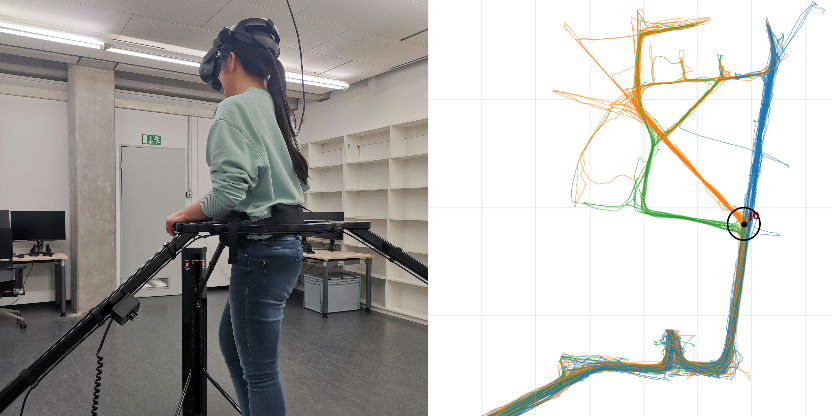
Sudden infrastructure failures can disrupt evacuation networks and force rapid route reconfiguration under time pressure. While evacuation research often focuses on travel times or path efficiency, less attention has been given to discrete route choice behavior following abrupt topological disruption. This study investigates how individuals redistribute across alternative paths after the removal of a critical network edge in an immersive virtual reality (VR) flood scenario based on an urban district in Frankfurt, Germany.
Participants (N = 128) initially followed a designated evacuation route. Midway, a bridge collapse removed a key network edge, forcing rerouting at a downstream decision node with three available outgoing branches. We model the street system as an undirected graph with locally directional choice sets and analyze resulting route choices. We quantify redistribution using empirical branch selection probabilities, a chi-square test against uniform allocation, and Shannon entropy as a concentration measure.
Results reveal stable and non-uniform redistribution patterns across branches, with branch preferences aligning with simple geometric properties of the available alternatives, including directional continuity, path length, and detour. Redistribution was largely invariant to demographic and experience-related attributes, suggesting a dominant role of geometry in this setting. Even in the absence of crowd interaction, consistent branch distributions emerge. These findings highlight the importance of topological structure in shaping evacuation behavior under disruption and demonstrate how immersive experiments can inform network-level resilience analysis.
References
Edrissi, A., Nourinejad, M., Roorda, M.J.: Transportation network reliability in emergency response. Transportation Research Part E: Logistics and Transportation Review 80, 56-73 (2015). doi:10.1016/j.tre.2015.05.005
Lim, G.J., Baharnemati, M.R., Kim, S.J.: An optimization approach for real time evacuation reroute planning. Annals of Operations Research 238(1), 375-388 (2016). doi:10.1007/s10479-015-2072-5
Gao, F., Du, Z., Fang, C., Zhou, L., Werner, M.: A Spatio-Temporal Cognitive Framework for Individual Route Choice in Outdoor Evacuation Scenarios. ISPRS International Journal of Geo-Information 11(12) (2022). doi:10.3390/ijgi11120605
Adjei, E., Benedict, B.C., Murray-Tuite, P., Lee, S., Ukkusuri, S., Ge, Y.G.: Effects of risk perception and perceived certainty on evacuate/stay decisions. International Journal of Disaster Risk Reduction 80, 103247 (2022). doi:10.1016/j.ijdrr.2022.103247
Fraser, T., Aldrich, D.P., Morikawa, L.: Do all roads lead to Sapporo? The role of linking and bridging ties in evacuation decisions. Ecology and Society 27(2), art3 (2022). doi:10.5751/ES-13097-270203
Sadri, A.M., Ukkusuri, S.V., Ahmed, M.A.: Review of social influence in crisis communications and evacuation decision-making. Transportation Research Interdisciplinary Perspectives 9, 100325 (2021). doi:10.1016/j.trip.2021.100325
Kinateder, M., Comunale, B., Warren, W.H.: Exit choice in an emergency evacuation scenario is influenced by exit familiarity and neighbor behavior. Safety Science 106, 170-175 (2018). doi:10.1016/j.ssci.2018.03.015
Natapov, A., Parush, A., Laufer, L., Fisher-Gewirtzman, D.: Architectural features and indoor evacuation wayfinding: The starting point matters. Safety Science 145, 105483 (2022). doi:10.1016/j.ssci.2021.105483
Feng, Z., González, V.A., Amor, R., Lovreglio, R., Cabrera-Guerrero, G.: Immersive virtual reality serious games for evacuation training and research: A systematic literature review. Computers & Education 127, 252-266 (2018). doi:10.1016/j.compedu.2018.09.002
Gagliardi, E., Bernardini, G., Quagliarini, E., Schumacher, M., Calvaresi, D.: Characterization and future perspectives of Virtual Reality Evacuation Drills for safe built environments: A Systematic Literature Review. Safety Science 163, 106141 (2023). doi:10.1016/j.ssci.2023.106141
Hung, M.C., Lin, C.Y., Hsiao, G.L.K.: Virtual Reality in Building Evacuation: A Review. Fire 8(2), 80 (2025). doi:10.3390/fire8020080
Tong, Y., Bode, N.W.F.: The principles of pedestrian route choice. Journal of The Royal Society Interface 19(189), 20220061 (2022). doi:10.1098/rsif.2022.0061
Imanishi, M., Sano, T.: Route Choice and Flow Rate in Theatre Evacuation Drills: Analysis of Walking Trajectory Data-Set. Fire Technology 55(2), 569-593 (2019). doi:10.1007/s10694-018-0783-2
Guo, R.Y., Huang, H.J., Wong, S.C.: Collection, spillback, and dissipation in pedestrian evacuation: A network-based method. Transportation Research Part B: Methodological 45(3), 490-506 (2011). doi:10.1016/j.trb.2010.09.009
Schadschneider, A., Klingsch, W., Klüpfel, H., Kretz, T., Rogsch, C., Seyfried, A.: Evacuation Dynamics: Empirical Results, Modeling and Applications. In: Encyclopedia of Complexity and Systems Science, pp. 3142-3176. Springer, New York, NY (2009). doi:10.1007/978-0-387-30440-3_187
Choi, J., Wehde, W.: Trust in Emergency Management Authorities and Individual Emergency Preparedness for Tornadoes. Risk, Hazards & Crisis in Public Policy 11(1), 12-34 (2020). doi:10.1002/rhc3.12185
Onuma, H., Shin, K.J., Managi, S.: Household preparedness for natural disasters: Impact of disaster experience and implications for future disaster risks in Japan. International Journal of Disaster Risk Reduction 21, 148-158 (2017). doi:10.1016/j.ijdrr.2016.11.004
Ermagun, A., Janatabadi, F.: Compound risk of wildfire and inaccessible shelters is disproportionately impacting disadvantaged communities. Progress in Disaster Science 23, 100358 (2024). doi:10.1016/j.pdisas.2024.100358
Sun, Y., Forrister, A., Kuligowski, E.D., Lovreglio, R., Cova, T.J., Zhao, X.: Social vulnerabilities and wildfire evacuations: A case study of the 2019 Kincade fire. Safety Science 176, 106557 (2024). doi:10.1016/j.ssci.2024.106557
Zhang, H., Wang, J., Shi, B., Lu, X., Jia, J.: Exploring significant edges of public transport network under targeted attacks. Modern Physics Letters B 33(10), 1950114 (2019). doi:10.1142/S0217984919501148
Zhang, L., Lu, J., Fu, B.b., Li, S.b.: A cascading failures model of weighted bus transit route network under route failure perspective considering link prediction effect. Physica A: Statistical Mechanics and its Applications 523, 1315-1330 (2019). doi:10.1016/j.physa.2019.04.122
Haghani, M., Sarvi, M.: Crowd behaviour and motion: Empirical methods. Transportation Research Part B: Methodological 107, 253-294 (2018). doi:10.1016/j.trb.2017.06.017
Kuligowski, E.: Predicting Human Behavior During Fires. Fire Technology 49(1), 101-120 (2013). doi:10.1007/s10694-011-0245-6
Sheu, J.B.: Mass evacuation planning for disasters management: A household evacuation route choice behavior analysis. Transportation Research Part E: Logistics and Transportation Review 186, 103544 (2024). doi:10.1016/j.tre.2024.103544
Jung, J.W., Gibson, K.: The Use of Landmarks in Fire Emergencies: A Study of Gender and the Descriptive Quality of Landmarks on Successful Wayfinding. Journal of Interior Design 32(2), 45-57 (2007). doi:10.1111/j.1939-1668.2006.tb00312.x
Lin, J., Cao, L., Li, N.: How the completeness of spatial knowledge influences the evacuation behavior of passengers in metro stations: A VR-based experimental study. Automation in Construction 113, 103136 (2020). doi:10.1016/j.autcon.2020.103136
Shi, J., Ding, N., Wang, Y., Zhang, E.: Individual route choice behavior in evacuation considering avoidance and phototropism: An experimental study. Physica A: Statistical Mechanics and its Applications 651, 130030 (2024). doi:10.1016/j.physa.2024.130030
Helbing, D., Farkas, I., Vicsek, T.: Simulating dynamical features of escape panic. Nature 407(6803), 487-490 (2000). doi:10.1038/35035023
Lovreglio, R., Fonzone, A., dell’Olio, L., Borri, D.: A study of herding behaviour in exit choice during emergencies based on random utility theory. Safety Science 82, 421-431 (2016). doi:10.1016/j.ssci.2015.10.015
Haghani, M., Cristiani, E., Bode, N.W.F., Boltes, M., Corbetta, A.: Panic, Irrationality, and Herding: Three Ambiguous Terms in Crowd Dynamics Research. Journal of Advanced Transportation 2019(1), 9267643 (2019). doi:10.1155/2019/9267643
Kim, J., Lee, S., Lee, S.: An evacuation route choice model based on multi-agent simulation in order to prepare Tsunami disasters. Transportmetrica B: Transport Dynamics 5(4), 385-401 (2017). doi:10.1080/21680566.2016.1147002
Liao, W., Kemloh Wagoum, A.U., Bode, N.W.F.: Route choice in pedestrians: determinants for initial choices and revising decisions. Journal of The Royal Society Interface 14(127), 20160684 (2017). doi:10.1098/rsif.2016.0684
Abu-Safieh, S.F.: Virtual Reality Simulation of Architectural Clues’ Effects on Human Behavior and Decision Making in Fire Emergency Evacuation. In: Peacock, R.D., Kuligowski, E.D., Averill, J.D. (eds.) Pedestrian and Evacuation Dynamics, pp. 337-347. Springer US, Boston, MA (2011). doi:10.1007/978-1-4419-9725-8_31
Mattsson, L.G., Jenelius, E.: Vulnerability and resilience of transport systems – A discussion of recent research. Transportation Research Part A: Policy and Practice 81, 16-34 (2015). doi:10.1016/j.tra.2015.06.002
Kemloh Wagoum, A.U., Seyfried, A., Holl, S.: Modeling the Dynamic Route Choice of Pedestrians to Assess the Criticality of Building Evacuation. Advances in Complex Systems 15(07), 1250029 (2012). doi:10.1142/S0219525912500294
Bergantino, A.S., Gardelli, A., Rotaris, L.: Assessing transport network resilience: empirical insights from real-world data studies. Transport Reviews 44(4), 834-857 (2024). doi:10.1080/01441647.2024.2322434
Du, J., Cui, J., Ren, G., Thompson, R.G., Zhang, L.: Cascading failures and resilience evolution in urban road traffic networks with bounded rational route choice. Physica A: Statistical Mechanics and its Applications 664, 130456 (2025). doi:10.1016/j.physa.2025.130456
Irsyad, H.A.W., Hitoshi, N.: Flood disaster evacuation route choice in Indonesian urban riverbank kampong: Exploring the role of individual characteristics, path risk elements, and path network configuration. International Journal of Disaster Risk Reduction 81, 103275 (2022). doi:10.1016/j.ijdrr.2022.103275
Albert, R., Jeong, H., Barabási, A.L.: Error and attack tolerance of complex networks. Nature 406(6794), 378-382 (2000). doi:10.1038/35019019
Latora, V., Marchiori, M.: Vulnerability and protection of infrastructure networks. Physical Review E 71(1), 015103 (2005). doi:10.1103/PhysRevE.71.015103
Derrible, S., Kennedy, C.: The complexity and robustness of metro networks. Physica A: Statistical Mechanics and its Applications 389(17), 3678-3691 (2010). doi:10.1016/j.physa.2010.04.008
Suhre, N., Cai, M.: VERTA: A python package for analyzing route choices in virtual environments. SoftwareX 35, 102854 (2026). doi:10.1016/j.softx.2026.102854
Shannon, C.E.: A mathematical theory of communication. The Bell System Technical Journal 27(3), 379-423 (1948). doi:10.1002/j.1538-7305.1948.tb01338.x
Downloads
Published
How to Cite
Issue
Section
License
Copyright (c) 2026 Niklas Suhre, Meng Cai, Michael Kraus, Uwe Rüppel, Eva Kassens-Noor

This work is licensed under a Creative Commons Attribution 4.0 International License.
Authors contributing to Collective Dynamics agree to publish their articles under the Creative Commons Attribution 4.0 license.
This license allows:
Share — copy and redistribute the material in any medium or format
Adapt — remix, transform, and build upon the material
for any purpose, even commercially.
The licensor cannot revoke these freedoms as long as you follow the license terms.
Authors retain copyright of their work. They are permitted and encouraged to post items submitted to Collective Dynamics on personal or institutional websites and repositories, prior to and after publication (while providing the bibliographic details of that publication).